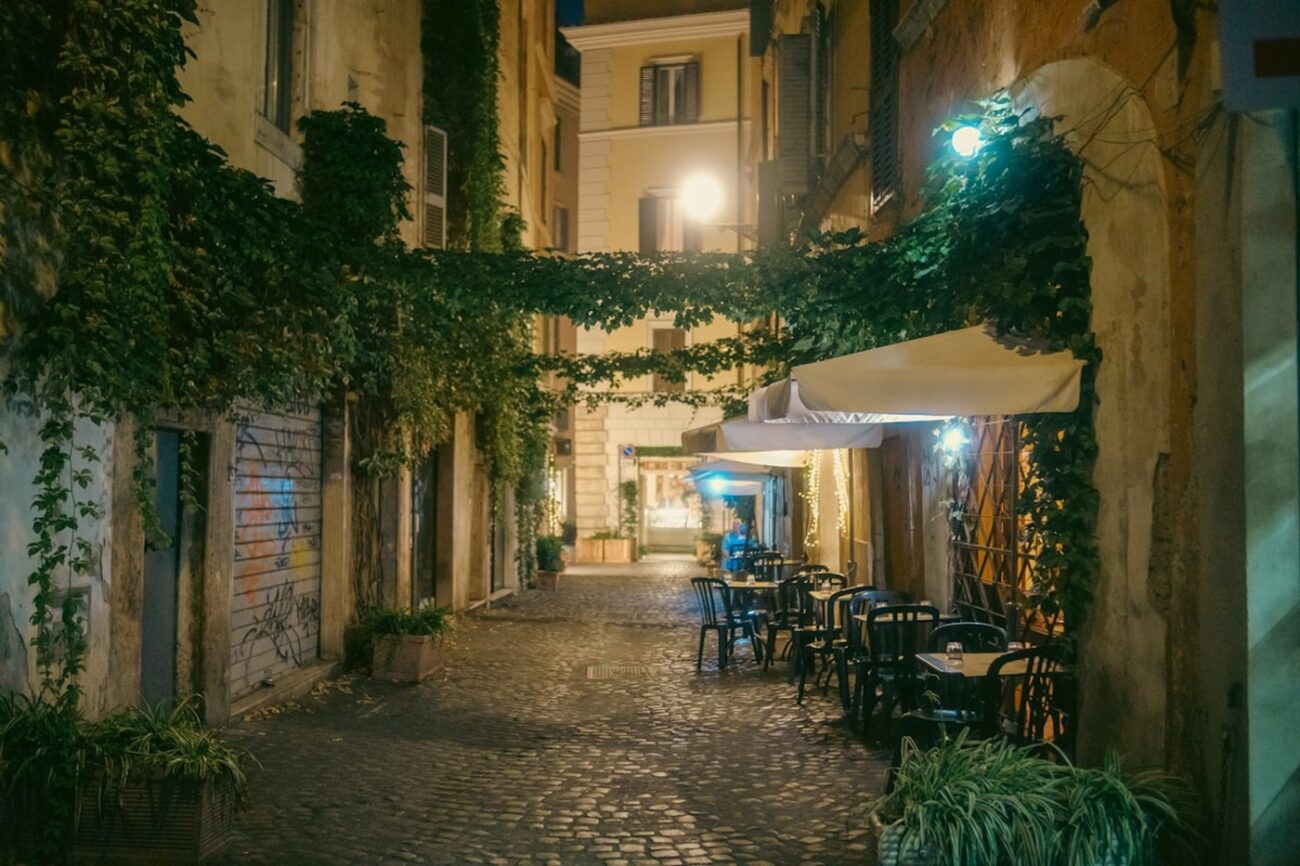
Trastevere is the neighborhood on the west bank of the Tiber River whose name derives from the Latin trans Tiberim, meaning “beyond the Tiber.” It has been part of Rome’s administrative structure since Emperor Augustus divided the city into 14 districts around 7 BC. For most of its history, Trastevere was a working-class quarter of fishermen, sailors, and immigrants — first Etruscans, then Jewish and Syrian communities who settled here during the Roman Republic.
Today Trastevere is one of Rome’s most visited neighborhoods after dark, and that popularity has created a predictable problem: tourist traps outnumber genuinely good restaurants by a wide margin. This guide covers how to navigate the Trastevere and Jewish Ghetto area at night — where to eat well, what to see, and how to avoid spending €18 on a plate of carbonara that tastes like it came from a microwave.
What Makes Trastevere Worth Visiting in the Evening?
The neighborhood’s appeal after dark is straightforward: narrow medieval cobblestone streets, ivy-covered ochre buildings, outdoor dining on nearly every block, and a concentration of restaurants and bars that no other Roman neighborhood matches. Piazza di Santa Maria in Trastevere — the neighborhood’s central square — functions as an informal gathering point where street musicians perform against the facade of the Basilica di Santa Maria in Trastevere, one of Rome’s oldest churches, with origins reportedly dating to the 340s AD. The basilica’s 13th-century gold mosaics on the upper facade are illuminated at night and are genuinely striking.
The atmosphere shifts noticeably around 7:00 PM. Daytime Trastevere is quieter. Evening Trastevere draws a younger crowd — both Romans and tourists — and the narrow streets between Piazza Trilussa and Piazza di Santa Maria fill with people moving between aperitivo spots, trattorias, and gelaterias. By 10:00 PM on a summer weekend, the density of foot traffic can make certain streets difficult to navigate.
Where Should You Eat in Trastevere?
The fundamental problem with eating in Trastevere is that the neighborhood’s reputation as a dining destination has attracted exactly the kind of restaurants that cash in on reputation rather than food quality. The streets immediately surrounding Piazza di Santa Maria are generally the worst offenders — high prices, mediocre execution, and menus printed in six languages.
The better options tend to be on the quieter streets south and west of the main piazza, particularly around Via di San Cosimato and the smaller lanes near Santa Cecilia in Trastevere.
Traditional Roman Trattorias
Roman cuisine centers on a handful of dishes executed with specific technique and specific ingredients. The four canonical Roman pastas — carbonara, cacio e pepe, amatriciana, and gricia — are available at nearly every restaurant in the neighborhood, but quality varies enormously.
Da Enzo al 29, on Via dei Vascellari, is widely considered one of Trastevere’s strongest trattorias for traditional Roman cooking. It is a small, family-run operation that does not take reservations, which means arriving before 7:30 PM or accepting a wait that can stretch past 45 minutes during peak season. The carciofi alla giudia and rigatoni alla carbonara are the dishes that generate the most consistent praise. Prices are moderate — roughly €12 to €15 for a primo.
Checco er Carettiere, operating since the early 1900s, represents the older generation of Trastevere restaurants — traditional Roman cuisine served in a setting that has not changed much in decades. The portions are large, the atmosphere is unapologetically old-fashioned, and the menu runs deep across Roman classics including saltimbocca alla romana and abbacchio (spring lamb).
Aperitivo Culture
The Italian aperitivo tradition — a pre-dinner drink accompanied by food — is well represented in Trastevere. Freni e Frizioni, on Via del Politeama near Piazza Trilussa, is arguably the most popular aperitivo bar in the neighborhood, known for its vegetarian aperitivo buffet included with the price of a drink. Arrive before 7:00 PM if you want outdoor seating.
Pizza
Two distinct pizza traditions exist in Rome. Pizza tonda is the round, sit-down variety served as a full meal — thinner and crispier than Neapolitan pizza. Pizza al taglio is sold by weight, cut with scissors, and eaten standing or walking. Ai Marmi, on Viale di Trastevere, is one of the neighborhood’s most established pizzerias for pizza tonda. Locals sometimes call it “L’Obitorio” (the morgue) because of its marble counters and fluorescent lighting — the decor is purely functional, but the pizza is reliable and inexpensive.
Gelato
Genuine artisanal gelato is stored in covered metal pans and has a flatter, less dramatic appearance. Avoid any shop displaying gelato in tall, brightly colored mounds — that presentation typically indicates stabilizers and artificial coloring. Fatamorgana, which has a location in Trastevere, uses natural ingredients and offers unusual flavor combinations alongside traditional options.
What Should You See While Walking Through Trastevere?
Basilica di Santa Maria in Trastevere
The basilica on the central piazza is believed to be one of the oldest churches in Rome, with foundations reportedly dating to the third or fourth century AD. The current structure is largely 12th-century. The nave is supported by 22 granite columns taken from the ruins of the Baths of Caracalla, and the apse mosaics — depicting the life of the Virgin Mary — were executed by Pietro Cavallini around 1291 and are considered among the finest medieval mosaics in Rome. Visiting at dusk when the interior is lit but the tourist density has thinned is generally a better experience than midday.
Santa Cecilia in Trastevere
Less visited than Santa Maria but architecturally significant, the Basilica di Santa Cecilia sits on what tradition holds was the site of the Roman house where Saint Cecilia — the patron saint of music — was martyred in the second or third century AD. The basilica also contains Stefano Maderno’s 1600 sculpture of Saint Cecilia, reportedly based on the position of her body when her tomb was opened in 1599 — one of the most reproduced sculptures of the early Baroque period.
The Janiculum Hill Viewpoint
Walking uphill from Trastevere toward the Janiculum rewards you with one of the best panoramic views of Rome — arguably better than the view from Pincian Hill above the Spanish Steps because it is less crowded. Piazzale Giuseppe Garibaldi has a 360-degree view that extends from St. Peter’s Basilica across the Tiber to the Colosseum. The walk takes roughly 15 to 20 minutes from Piazza di Santa Maria in Trastevere and is particularly worth doing around sunset.
How Do You Get to Trastevere?
Trastevere has no metro station. Most visitors reach Trastevere on foot from the historic center — crossing Ponte Sisto from the Campo de’ Fiori area is the most scenic approach and takes about 10 minutes. Tram 8 runs along Viale di Trastevere from Piazza Venezia and stops at several points within the neighborhood.
Is Trastevere Safe at Night?
Generally, yes. Trastevere is one of Rome’s busiest nightlife neighborhoods and the streets remain populated well past midnight. The standard Rome precautions apply: be aware of pickpockets in crowded areas, do not leave belongings unattended at outdoor tables.
When Should You Avoid Trastevere?
Friday and Saturday nights between June and September are the most crowded periods. If you want the atmosphere without the crush, weeknight evenings — particularly Tuesday through Thursday — offer a substantially better experience.
Frequently Asked Questions
Do you need reservations for Trastevere restaurants?
It depends on the restaurant. Higher-end spots and popular trattorias like Taverna Trilussa generally accept reservations and fill up quickly on weekends. More casual places like Da Enzo al 29 do not take reservations at all. Arriving before 7:30 PM or after 9:30 PM gives you the best chance of seating without a long wait.
What is the best time to arrive in Trastevere for dinner?
Plan to arrive around 6:00 PM if you want to start with an aperitivo before dinner. The aperitivo window runs roughly from 6:00 to 8:00 PM at most bars. For dinner without aperitivo, 7:30 PM is the standard Italian dining hour.
How much does a typical dinner in Trastevere cost?
At a mid-range trattoria, expect to spend approximately €30 to €45 per person for a primo, a secondo or contorno, a glass of house wine, and a coperto (cover charge, typically €2 to €3). Pizza al taglio and street food options bring the cost down to roughly €8 to €15 for a filling meal.
