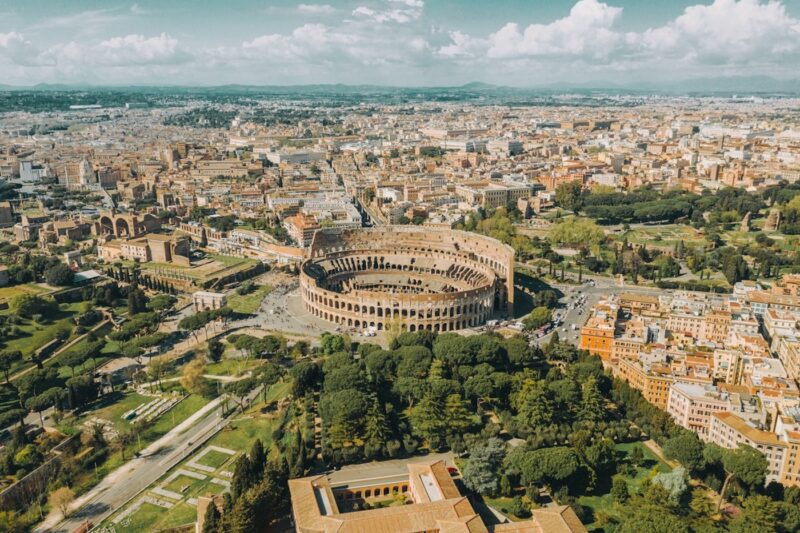
The Roman Forum is the archaeological remains of what was, for roughly a thousand years, the political, religious, and commercial center of the Roman Empire. It occupies the valley between the Palatine and Capitoline Hills in central Rome, and your standard €18 Colosseum ticket includes entry to both the Forum and Palatine Hill within a 24-hour window. What the ticket does not include is any coherent way to understand what you are looking at — the site has minimal signage, no marked route, and no shade.
Most visitors enter from the Via dei Fori Imperiali side, walk the Via Sacra in a straight line, look at columns they cannot identify, and leave within 30 minutes feeling vaguely disappointed. This guide provides a route that sequences the ruins chronologically and spatially so you can actually read the site. For broader planning around the Colosseum and Roman Forum area, see our experience hub.
Why Does the Route Matter?
The Forum spans roughly 14 centuries of continuous use, from the 8th century BC through the 6th century AD. A temple built in 497 BC stands next to an arch erected in 203 AD. Republican-era basilicas were rebuilt by emperors. Pagan temples became Christian churches in the 4th and 5th centuries. Without a route that accounts for this layering, the ruins look like a random collection of broken columns.
The additional problem is physical. According to experienced guides and travel writers, the Forum’s ancient paving stones along the Via Sacra are notoriously uneven, worn smooth by two millennia of foot traffic, and slippery when wet. The site has almost no shade. During summer months, temperatures on the exposed stone regularly exceed 35°C. Visitors who enter from the main Via dei Fori Imperiali gate face an uphill climb along the Via Sacra directly into the sun — arguably the single most common cause of what seasoned Rome visitors call “ruin fatigue.”
The smarter approach, recommended by archaeologists and walking tour operators, is to enter from the Palatine Hill gate on Via di San Gregorio, approximately a 4-minute walk south of the Colosseum past the Arch of Constantine. This entrance typically has shorter queues, starts you on higher ground with shade from the Farnese Gardens, and gives you a panoramic overview of the entire Forum before you descend into it.
What Is the Best Walking Route?
Start at the Palatine Hill entrance on Via di San Gregorio. From there, climb to the summit where emperors Augustus and Domitian built their palaces — the Domus Augustana and Domus Flavia — between roughly 27 BC and 92 AD. The foundations and terraced walls here give you a sense of the scale of imperial life that no Forum-level view provides.
From the Palatine summit, walk to the 16th-century Farnese Gardens, built by Cardinal Alessandro Farnese in 1550 on top of the ruins of Tiberius’s palace. The terrace here offers the single best overhead view of the Forum. Spend 5 minutes here orienting yourself: the Capitoline Hill is to your right, the Colosseum behind you, and the entire Forum valley spreads below. According to multiple walking tour guides, mentally mapping the layout from above before descending makes the ground-level experience significantly more coherent.
Descend from Palatine Hill into the Forum proper. Your first major structure is the House of the Vestal Virgins, the residence of the priestesses who maintained Rome’s sacred flame from approximately the 7th century BC until Emperor Theodosius I ordered the flame extinguished in 394 AD. The partially reconstructed courtyard with its statuary bases and central pool gives you one of the Forum’s most photogenic compositions.
Continue northwest along the Via Sacra — now walking downhill with the sun generally behind you if visiting in the morning. The key structures to identify, in sequence:
– Temple of Antoninus and Faustina (141 AD): One of the best-preserved structures because it was converted to the church of San Lorenzo in Miranda in the 7th century. The original Corinthian columns still stand at full height.
– Basilica Aemilia (179 BC, rebuilt multiple times): Largely foundations now, but the green-stained marble floor preserves evidence of the fire during Alaric’s sack of Rome in 410 AD — the copper coins melted into the stone are still visible.
– The Curia Julia (44 BC, rebuilt 283 AD): The Senate house where Roman senators debated. The current brick building is a remarkably intact reconstruction from the reign of Emperor Diocletian. The original bronze doors were reportedly removed to the Basilica of San Giovanni in Laterano in the 17th century.
– The Rostrum: The public speaking platform where Mark Antony is believed to have delivered Caesar’s funeral oration in 44 BC. The platform originally displayed the prows (rostra) of captured enemy warships.
– Arch of Septimius Severus (203 AD): A 21-meter triumphal arch commemorating victories over the Parthians. The reliefs depicting military campaigns are still largely intact and legible from ground level.
– Temple of Saturn (497 BC, rebuilt 42 BC): Eight surviving columns mark what was both a temple and Rome’s state treasury. The columns you see today date from the 4th-century AD reconstruction.
What Do Most Visitors Miss?
Three elements that the standard walk-through typically skips but that substantially deepen the visit:
The medieval church of Santa Maria Antiqua, located near the base of Palatine Hill, is generally considered the oldest surviving Christian monument in the Forum. According to art historians, it contains 6th-through-8th-century frescoes that represent some of the earliest Christian art in Rome. The church was buried by an earthquake in 847 AD and not excavated until the early 20th century, which preserved the frescoes in remarkable condition. Access requires the Full Experience or SUPER sites ticket upgrade.
The Lapis Niger, near the Arch of Septimius Severus, is a section of black marble paving that marks what ancient Romans themselves considered a sacred and mysterious spot. According to classical sources including Plutarch and the Roman antiquarian Varro, it was believed to be associated with the grave of Romulus or an early king. The underground chamber beneath the black stones contains one of the oldest known Latin inscriptions, dating to approximately the 6th century BC.
The Temple of Castor and Pollux, identifiable by its three standing Corinthian columns, is one of the most photographed structures in the Forum. What most visitors do not realize is that the three columns visible today are all that remain of a much larger temple originally dedicated in 484 BC. By the 15th century, the nearby street was nicknamed “The Road of Three Pillars,” and preservation efforts in 1760 stabilized the columns to prevent their collapse.
How Long Should You Spend?
Plan a minimum of 90 minutes for the Forum highlights route described above. If you add the Palatine Hill circuit — which your ticket includes and which arguably provides the best views — budget 2.5 to 3 hours total. According to site guides, serious architectural exploration can take 4 hours or more.
Timing matters significantly. Weekday mornings at the 8:30 AM opening offer the smallest crowds, particularly between November and February when visitor numbers reportedly drop by roughly 40% compared to peak summer. By 10:00 AM from March through October, the site becomes uncomfortably crowded. Late afternoon visits after 3:00 PM offer better golden-hour lighting and decreasing crowds as the site approaches closing time.
If you are combining this with a Colosseum underground tour, consider splitting them across two days — your ticket allows entry to the Forum and Palatine within 24 hours of your Colosseum visit. Rushing both in a single morning is perhaps the most common planning mistake visitors make with the ancient center, and it generally produces diminished appreciation of both sites. For a full sequencing plan, see our Rome in 3 days itinerary.
What Should You Bring?
The Forum is an exposed archaeological site with limited amenities. Water is essential — bring at least 1.5 liters per person, as there are no fountains or vendors within the ticketed area. Sturdy walking shoes with ankle support and aggressive tread are strongly recommended; the ancient paving stones are uneven and slippery, and twisted ankles are reportedly common among visitors wearing sandals or smooth-soled shoes.
Sun protection is critical from April through October. A hat and sunscreen are not optional — the Forum has almost no tree cover, and the stone surfaces reflect and radiate heat. In winter months, Rome averages 10 to 12 rainy days per month, so a waterproof outer layer is advisable. The valley between the hills can create unexpected wind tunnels.
Large bags are subject to security screening at entry. No food is permitted inside except water. Download a map or guidebook to your phone before entering, as on-site information panels are sparse.
Frequently Asked Questions
Do you need a separate ticket for the Roman Forum?
No. Your standard €18 Colosseum ticket includes one entry to the Roman Forum and Palatine Hill within a 24-hour window centered on your Colosseum time slot. If you book the Full Experience ticket at approximately €28, it extends to two consecutive days and adds access to the SUPER sites within the Forum and Palatine area.
Can you visit the Roman Forum without a guide?
Yes. The Forum is fully accessible for self-guided visits during operating hours, which generally run from 8:30 AM until one hour before sunset — ranging from approximately 4:30 PM in winter to 7:15 PM in summer. However, the site’s minimal signage means you will get substantially more from the visit with either a guidebook, an audio guide, or a licensed tour guide. The free MyColosseum app, released by the Parco Archeologico del Colosseo, offers an interactive audio guide in Italian and English.
Is the Roman Forum accessible for wheelchair users?
Partially. The main Via Sacra path through the Forum is relatively flat but uneven. Access to Palatine Hill involves steep inclines and stairs. According to visitor accessibility guides, wheelchair users can navigate portions of the Forum floor but should expect significant limitations on the Palatine Hill circuit and in the underground or elevated sections.
What is the difference between the Roman Forum and the Imperial Fora?
The Roman Forum is the older site in the valley between Palatine and Capitoline Hills, used from roughly the 8th century BC. The Imperial Fora are a separate complex built by successive emperors — Julius Caesar in 46 BC, Augustus in 2 BC, Nerva in 97 AD, and Trajan in 112 AD — along what is now Via dei Fori Imperiali. According to the Parco Archeologico del Colosseo, they are distinct archaeological sites with separate access. Many visitors confuse the two, which leads to navigation problems.