The Pantheon is a Roman temple completed around 125 AD during the reign of Emperor Hadrian, rebuilt on the site of an earlier structure commissioned by Marcus Vipsanius Agrippa in 27 BC. Its dome — 43.3 meters in internal diameter — remains the largest unreinforced concrete dome ever built, a record it has held for nearly two thousand years. The interior height from floor to oculus matches the diameter precisely, meaning a perfect sphere could fit inside the rotunda. Over six million people visit annually, and since July 2023, every one of them needs a ticket.
How Much Does a Pantheon Ticket Cost?
Standard admission is €5 for adults. EU citizens between 18 and 25 pay a reduced rate of €3 with valid ID. Children under 18 enter free, though they still need a free ticket reserved through the official system. Rome residents are exempt from the fee entirely with proof of residency.
The official ticket platform is Musei Italiani, the Italian Ministry of Culture’s centralized booking system. There is a €1 booking fee per transaction regardless of the number of tickets purchased. Paying via PayPal tends to avoid the most common payment failures with Italian bank systems.
Audio guide tickets run approximately €10 to €15 on top of admission, and guided tour packages generally range from €20 to €30 per person.
When Is the Pantheon Free to Visit?
Admission is free on the first Sunday of every month. No online reservations are available for free Sundays — everyone queues at the entrance. The trade-off is obvious: the lines are substantially longer and the interior is packed. A weekday morning visit with a pre-booked ticket is a far better experience.
What Are the Opening Hours?
The Pantheon is open daily from 9:00 AM to 7:00 PM. The ticket office closes at 6:00 PM, with last admission for individual visitors at 6:30 PM. The building closes entirely on January 1, May 1, and December 25.
Hours are subject to change during religious celebrations — the Pantheon is an active Catholic church, formally named the Basilica di Santa Maria ad Martyres since Pope Boniface IV consecrated it in 609 AD.
How Bad Are the Queues?
During peak season — roughly June through September — wait times at the ticket purchase queue can exceed an hour according to multiple visitor reports. Even the pre-booked line involves a 10-to-15-minute security check that cannot be bypassed.
The practical advice: buy your ticket online at least a few days ahead, particularly for weekends and holidays when availability reportedly sells out two to three days in advance. Weekday mornings before 10:00 AM and late afternoons after 5:00 PM typically have the shortest waits.
What Should You Actually Look at Inside?
The Dome and Oculus
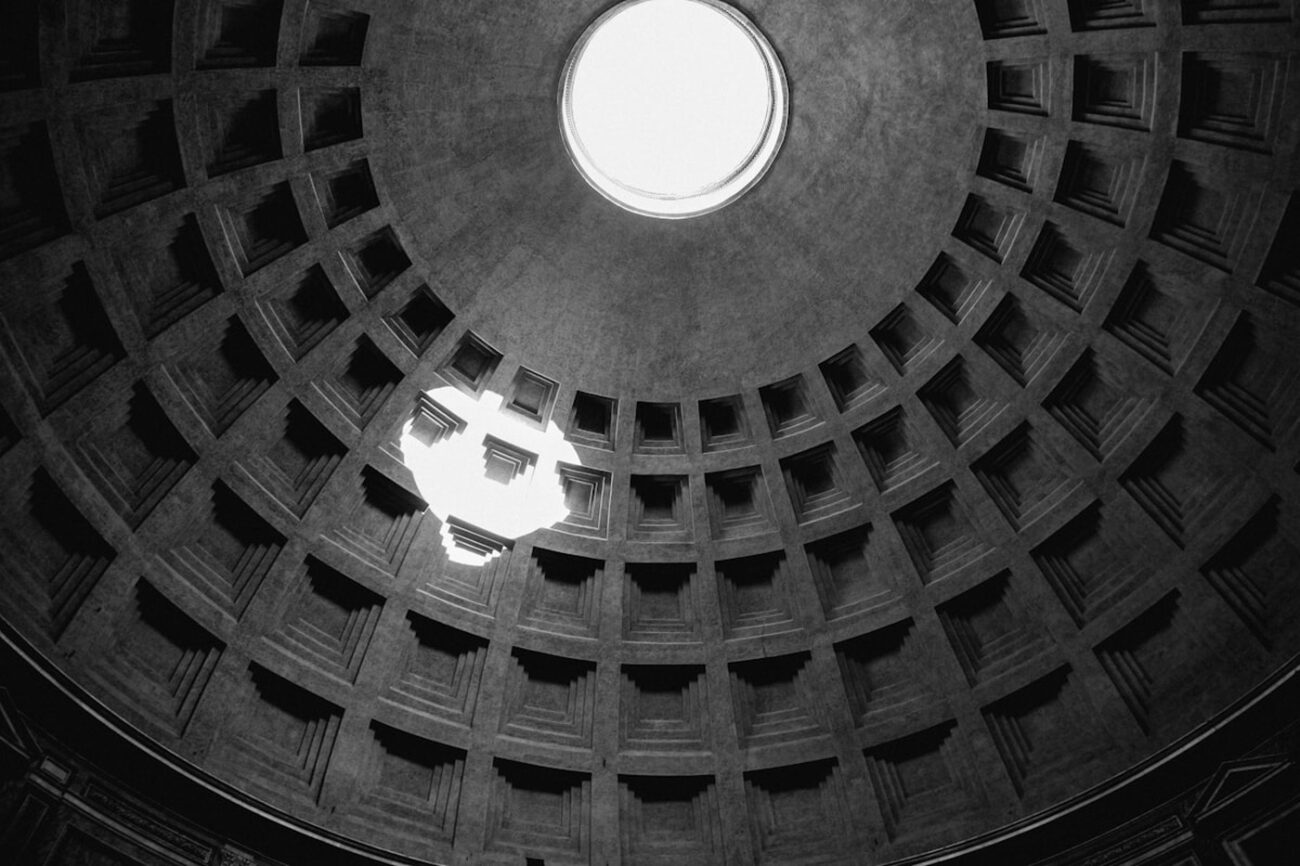
The dome is the reason this building matters. At 43.3 meters in diameter, it exceeds even St. Peter’s Basilica (42.5 meters) and Brunelleschi’s dome in Florence (42 meters). Roman engineers achieved this span without reinforcing steel by grading the concrete aggregate: heavy basalt and travertine at the base, lighter tufa in the middle sections, and volcanic pumice near the crown. The walls supporting the dome are approximately 6 meters thick.
The oculus — the 8.2-meter circular opening at the dome’s apex — is the building’s sole source of natural light. It is completely open to the sky. Rain does enter the building; the floor has a subtle drainage slope with 22 drain holes to manage it. The coffers — five rings of 28 rectangular recesses — reduce the dome’s weight while channeling structural forces through ribs, a technique considered one of the most sophisticated structural innovations of the ancient world.
Stand near the center around midday and watch the column of light move across the interior.
Raphael’s Tomb
The painter Raphael Sanzio died on April 6, 1520, at the age of 37, and was buried here at his own request. The Latin epitaph on the tomb, composed by Cardinal Pietro Bembo, translates roughly to: “Here lies Raphael, by whom Nature feared to be conquered while he lived, and when he was dying, feared herself to die.”
The tomb is in the third aedicula on the left side of the rotunda, surmounted by Lorenzetto’s sculpture of the Madonna del Sasso. In 1833, Pope Gregory XVI ordered the tomb opened to verify Raphael’s remains were inside. They were, and the pope donated an ancient sarcophagus from the Vatican Museums to hold them.
Annibale Carracci, the Baroque painter credited alongside Caravaggio with transforming Italian art in the early 1600s, is buried beside Raphael.
The Royal Tombs
Victor Emmanuel II, the first king of unified Italy, was buried here in 1878. His tomb occupies a prominent position on the right side of the rotunda. Nearby lies Umberto I, who ruled from 1878 until his assassination in 1900, alongside his wife Queen Margherita of Savoy.
The Portico and Bronze Doors
The sixteen granite Corinthian columns — each 11.8 meters tall and 1.5 meters in diameter — were quarried in Egypt at Mons Claudianus and transported by barge down the Nile, across the Mediterranean to the Roman port of Ostia, and then up the Tiber to Rome.
The bronze doors are 7.53 meters high and 4.45 meters wide. Analysis of the fusion technique confirmed them as the original Roman doors — among the oldest surviving monumental bronze doors in Rome.
How Long Should You Spend Inside?
Plan for 20 to 30 minutes for a self-guided visit if you want to see the dome, Raphael’s tomb, the royal tombs, and study the interior architecture. An audio guide extends this to roughly 40 to 50 minutes.
Is the Pantheon Wheelchair Accessible?
Yes. Wheelchair access is available through a side entrance separate from the main portico steps. The interior floor is level marble, and the single-room layout means there are no stairs or elevated sections to navigate once inside.
Do You Need to Dress Modestly?
The Pantheon is a consecrated church. While the dress code is not as strictly enforced as at St. Peter’s Basilica or the Vatican Museums, covered shoulders and knees are expected.
Frequently Asked Questions
Is the Pantheon included in the Roma Pass?
No. The Pantheon is not part of the Roma Pass or the Omnia Card circuit. You need a separate ticket purchased through Musei Italiani or a third-party operator.
Can you buy tickets at the door?
Yes, but the on-site ticket queue can stretch past an hour during peak season. Buying online through the official Musei Italiani platform or a licensed reseller is considerably faster.
Does it rain inside the Pantheon?
Yes. The oculus is open to the sky with no covering. When it rains, water falls onto the ancient marble floor and drains through a system of 22 small holes. Visiting in light rain is arguably one of the most atmospheric experiences the building offers.