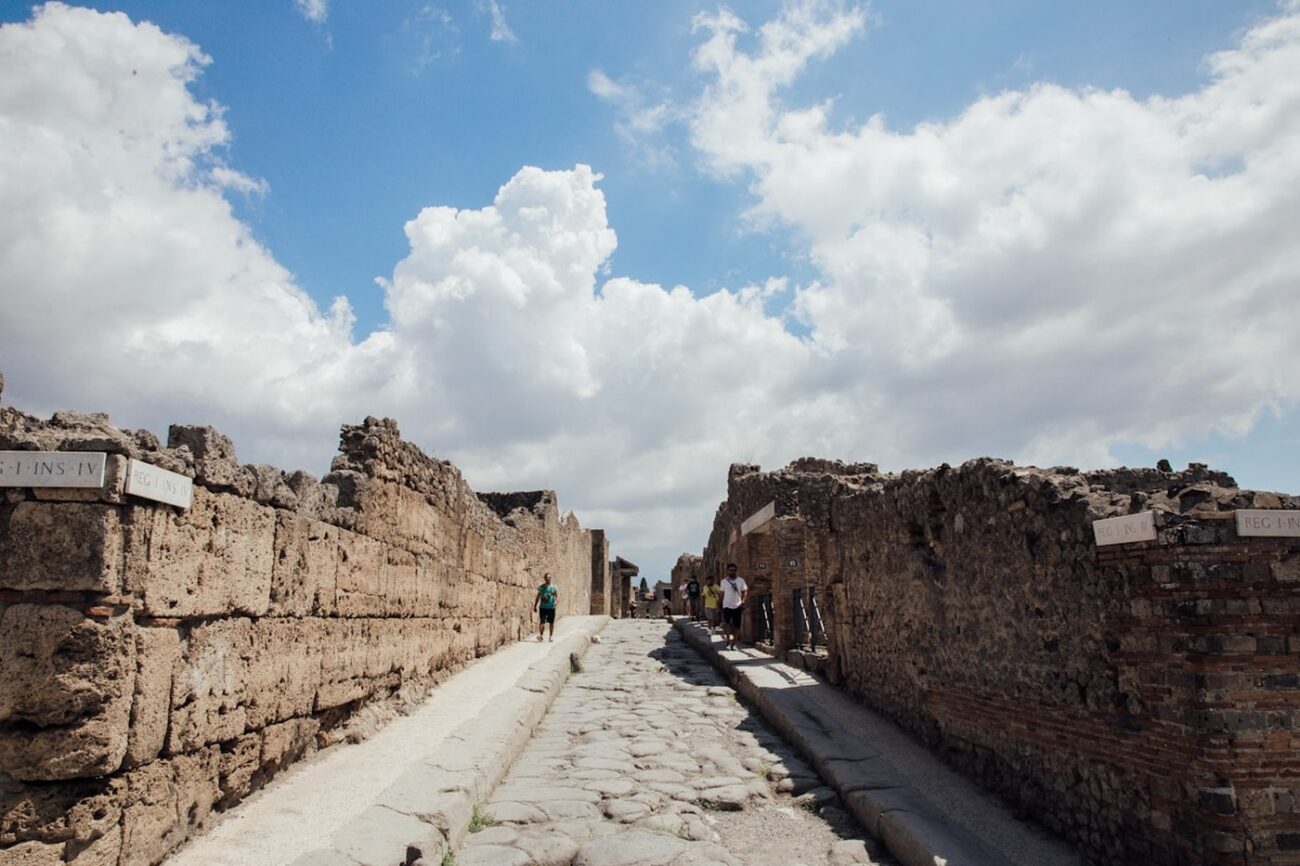
Pompeii is a Roman city buried under volcanic ash when Mount Vesuvius erupted in 79 AD, killing an estimated 2,000 of its roughly 11,000 inhabitants and preserving buildings, streets, frescoes, and even human remains in extraordinary detail. The archaeological site — a UNESCO World Heritage Site since 1997 — covers approximately 170 acres, of which about two-thirds have been excavated since systematic work began in 1748. It sits approximately 240 kilometers south of Rome, just southeast of modern Naples.
The question most visitors to Rome face is not whether Pompeii is worth seeing — it is — but whether the logistics of getting there and back in a single day justify the time cost when Rome itself has more than enough to fill a week.
How Do You Get from Rome to Pompeii?
There are three practical approaches.
Option 1: High-Speed Train to Naples + Local Train (DIY)
Trenitalia and Italo both operate high-speed trains from Roma Termini to Napoli Centrale with departures roughly every 30 minutes throughout the day. The journey takes approximately 70 minutes and costs between €13 and €45 each way, depending on how far in advance you book.
From Napoli Centrale, you transfer to the Circumvesuviana commuter train (operated by EAV) from the adjacent Napoli Garibaldi station. This local train runs to Sorrento with a stop at Pompeii Scavi — Villa dei Misteri, which is directly opposite the archaeological site’s main entrance. The Circumvesuviana takes approximately 35 minutes and costs roughly €3.20 each way.
The total journey time from Roma Termini to the Pompeii entrance is approximately two hours door-to-door. The last high-speed train back to Rome from Napoli Centrale typically departs around 8:30 PM, giving you roughly 5 to 6 hours at the site if you leave Rome by 8:00 AM.
Important cautions about the Circumvesuviana: Multiple travel guides note that this commuter train is not air-conditioned, can be extremely crowded, and is reportedly notorious for pickpockets. You specifically need the Pompeii Scavi — Villa dei Misteri stop, not the town station on the mainline.
Option 2: Guided Day Tour from Rome
Organized day tours handle all logistics — train tickets, transfers, skip-the-line entry, and often lunch. The typical format involves meeting at Roma Termini, taking the high-speed train to Naples, transferring by private air-conditioned coach to Pompeii, and spending 2 to 3 hours at the ruins with an archaeologist guide before returning to Rome. Total tour duration is generally 10 to 12 hours.
Prices for guided tours generally range from €120 to €180 per person depending on what is included.
The trade-off is flexibility: on a guided tour, you see what the guide chooses to show you in the time allocated, which is typically 2 to 2.5 hours inside the ruins.
Option 3: Bus Shuttle
Several operators run shuttle buses from near Roma Termini to Pompeii, departing around 7:30 AM and returning in the late afternoon. These are transport-only services with minimal or no commentary. The bus ride takes approximately 3 hours each way — roughly twice the train time — because the Rome-to-Naples motorway is subject to significant traffic.
What Should You See at Pompeii?
Plan for a minimum of 2 to 3 hours to see the highlights, or 4 to 5 hours if you want a more thorough exploration. The ruins are open daily except January 1, May 1, and December 25, with hours typically running from 9:00 AM to 7:30 PM in summer.
The Forum
The Forum was Pompeii’s civic, religious, and commercial center. The rectangular plaza is surrounded by the remains of temples, government buildings, and market halls, with Mount Vesuvius framing the view from the north end.
The Amphitheater
Built around 80 BC, Pompeii’s amphitheater is one of the oldest surviving Roman amphitheaters. It seated approximately 20,000 spectators — nearly double the city’s estimated population — and was used for gladiatorial contests.
The Villa of the Mysteries
Located just outside the main city walls near the Pompeii Scavi entrance, this villa contains one of the most important surviving cycles of Roman wall painting. The frescoes — believed to depict a Dionysian mystery initiation rite — date to the mid-first century BC and retain remarkably vivid color.
The Plaster Casts
Perhaps the most haunting feature of Pompeii is the plaster casts of victims, created by pouring plaster into the voids left in the ash by decomposed bodies. The technique was developed by archaeologist Giuseppe Fiorelli in 1863. The casts are displayed in several locations throughout the site.
Is the Pompeii Day Trip from Rome Actually Worth It?
Worth it if: You have 4 or more days in Rome, you have a genuine interest in archaeology or Roman history, and you have already seen Rome’s major sites.
Probably not worth it if: You have 3 days or fewer in Rome. The round trip consumes a minimum of 4 to 5 hours of travel time, which is a significant portion of a short visit.
The Ostia Antica alternative: If your primary interest is seeing a well-preserved Roman city but you do not want to spend the travel time required for Pompeii, consider Ostia Antica instead. Rome’s ancient port is a 30-minute train ride from Piramide station, costs €12 admission, is generally uncrowded even in peak season, and preserves many of the same types of structures — baths, apartments, shops, mosaics, a theater.
Frequently Asked Questions
How much does a Pompeii day trip from Rome cost?
A DIY trip by train costs approximately €40 to €100 round trip depending on when you book, plus €18 for Pompeii admission. A guided day tour from Rome typically costs €120 to €180 per person all-inclusive.
Can you combine Pompeii with Naples in one day?
Yes, and many visitors do. If you take an early train from Rome and spend 2 to 3 hours at Pompeii, you can return to Naples by mid-afternoon and spend a few hours exploring the city — particularly the National Archaeological Museum, which houses many of the original artifacts removed from Pompeii.
Should you visit Mount Vesuvius too?
It is possible to combine Pompeii and Vesuvius in one day, but it generally makes for an exhausting schedule. If your primary goal is Pompeii, adding Vesuvius may leave you rushed at the ruins. A guided tour that includes both stops is more efficient than trying to coordinate independently.
