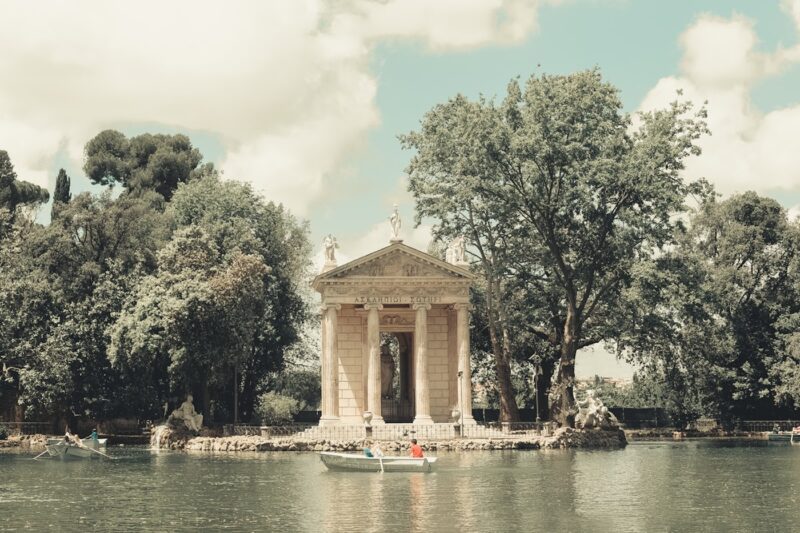
The Galleria Borghese is a collection of roughly 260 paintings and 170 sculptures housed in a 17th-century villa inside Rome’s Villa Borghese gardens. Visits are capped at 360 people per two-hour time slot. The collection was assembled primarily by Cardinal Scipione Borghese, nephew of Pope Paul V, between approximately 1605 and 1633.
Two hours sounds generous until you are inside. The gallery is spread across 20 rooms on two floors, and every room contains pieces that would anchor any other museum. What follows are the 10 works that most merit your limited time, sequenced by the room order that lets you move efficiently through the ground floor sculptures and then upstairs to the paintings.
How Should You Approach the Gallery?
Start on the ground floor, where Bernini’s sculptures are concentrated in Rooms I through IV. These are the gallery’s signature works, and seeing them when your attention is fresh makes a substantial difference. Most visitors who start upstairs with the paintings run out of time before reaching the sculptures — a significant loss given that the Bernini pieces are arguably the primary reason to visit.
Which Works Should You See First?
1. Apollo and Daphne — Room III (Bernini, 1622–1625)
This is widely considered the masterpiece of the gallery and one of the defining works of Baroque sculpture. Gian Lorenzo Bernini carved it between ages 23 and 27. It closely follows Ovid’s Metamorphoses: the moment the nymph Daphne transforms into a laurel tree to escape Apollo’s pursuit. Her fingers sprout leaves, bark climbs her legs, and Apollo’s expression shifts from desire to shock.
The sculpture is designed to be viewed in motion. Walking slowly around the piece reveals a deliberate narrative: from behind, you see only a woman running. As you circle to the front, the transformation progressively appears. Bernini was 23 when he began this work — the carving of the individual leaves at Daphne’s fingertips remains one of the most technically demanding feats in marble sculpture.
2. The Rape of Proserpina — Room IV (Bernini, 1621–1622)
Completed a year before Apollo and Daphne, this sculpture depicts Pluto abducting Proserpina to the underworld. It is the single most cited example of Bernini’s ability to make marble appear soft — Pluto’s fingers press into Proserpina’s thigh and the stone visibly dimples as though it were flesh. The musculature of Pluto’s hands and the tears on Proserpina’s cheek demonstrate a level of anatomical precision that scholars have described as unprecedented for the period.
3. David — Room II (Bernini, 1623–1624)
Bernini’s David differs fundamentally from both Donatello’s 1440s bronze and Michelangelo’s 1504 marble. Those versions depict David before or after the fight. Bernini chose the moment of maximum tension: David mid-wind, his body coiled, about to release the stone from his sling. Bernini reportedly used his own reflection to model David’s concentrated grimace.
4. Pauline Borghese as Venus Victrix — Room I (Canova, 1805–1808)
Antonio Canova’s neoclassical portrait of Napoleon’s sister, Pauline Bonaparte, reclining semi-nude as the goddess Venus, was considered scandalous when unveiled. The marble figure reclines on a wooden divan that originally rotated on a mechanism so viewers could see the sculpture from all angles.
5. Aeneas, Anchises, and Ascanius — Room VI (Bernini, 1618–1619)
This is one of Bernini’s earliest major sculptures, completed when he was approximately 20 years old. The work depicts Aeneas carrying his elderly father Anchises on his shoulders while his young son Ascanius walks alongside, fleeing the burning city of Troy. The three generations visible in the sculpture — the sagging flesh of the old man, the muscular torso of Aeneas, the smooth skin of the child — demonstrate Bernini’s ability to render different textures in a single block of marble even at this early stage.
6. David with the Head of Goliath — Room VIII (Caravaggio, c. 1609–1610)
The Borghese Gallery holds more Caravaggio paintings than any other museum in the world, and this is arguably the most psychologically complex of them all. Caravaggio painted the aftermath: David holds Goliath’s severed head with an expression that art historians have described as more sorrowful than triumphant. The face of Goliath is widely believed to be a self-portrait of Caravaggio himself, painted during his final years while he was on the run after killing a man in Rome in 1606.
7. Boy with a Basket of Fruit — Room VIII (Caravaggio, c. 1593–1594)
One of Caravaggio’s earliest known works, painted when he was roughly 22 years old and recently arrived in Rome from Milan. Cardinal Scipione Borghese acquired this painting through confiscation from another collector. The painting’s meticulous naturalism — including bruised and overripe fruit alongside fresh specimens — broke with the prevailing idealized conventions.
8. The Deposition — Room IX (Raphael, 1507)
Raphael painted this altarpiece at age 24 for the Baglioni family chapel in Perugia. Cardinal Scipione Borghese obtained it in 1608 by having it stolen from the church under cover of darkness — he subsequently secured a papal decree retroactively authorizing the seizure. The painting depicts Christ being carried to his tomb.
9. Sacred and Profane Love — Room XX (Titian, c. 1514)
Titian painted this large canvas when he was in his mid-twenties, likely as a commission for a Venetian wedding. Two women — one clothed, one nude — sit on either end of an ancient sarcophagus converted into a fountain. The meaning of the painting has been debated for centuries, with the nude figure generally interpreted as celestial love and the clothed figure as earthly love.
10. Lady with a Unicorn — Room IX (Raphael, c. 1506)
This portrait of an unidentified Florentine woman holding a small unicorn — a symbol of chastity and conjugal virtue in Renaissance iconography — is believed to have been influenced by Leonardo da Vinci’s Mona Lisa. X-ray analysis has revealed that the unicorn was originally painted as a small dog, then altered.
What Else Is Worth Seeing If You Have Time?
The Sleeping Hermaphrodite in Room I is a Roman marble copy of a 2nd-century BC Greek original. Viewed from behind, it appears to be a sleeping woman; walking to the front reveals the full figure. The ancient Roman floor mosaics in the entrance hall, believed to have come from the Baths of Caracalla, are easy to overlook but represent some of the finest surviving examples of imperial Roman decorative art.
Frequently Asked Questions
Can you photograph the works inside the Borghese Gallery?
Yes. Photography without flash is permitted throughout the gallery. Tripods and selfie sticks are prohibited.
Is a guided tour worth it at the Borghese Gallery?
For first-time visitors, arguably yes. The gallery provides minimal labeling and no audio guide of its own. A knowledgeable guide can contextualize the relationship between Bernini and his patron Scipione Borghese, explain Caravaggio’s biographical context in paintings like David with the Head of Goliath, and point out details that transform the visit from viewing into understanding.
How early should you arrive for your time slot?
Arrive 10 to 15 minutes before your reserved slot. Security screening is relatively quick given the controlled visitor numbers, but the gallery enforces its two-hour window strictly — entry typically closes 30 minutes before the slot ends, and staff will begin clearing rooms at the end of the period.