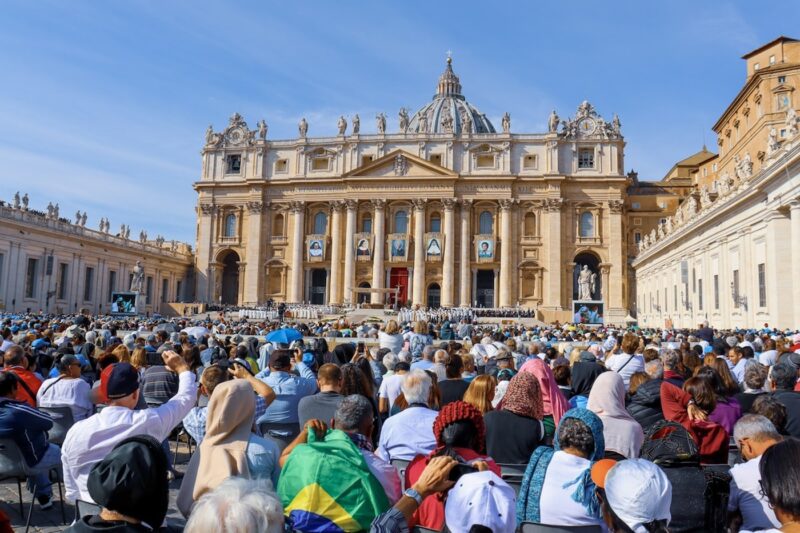
The dome of St. Peter’s Basilica is the tallest dome in Rome and the defining feature of the Vatican City skyline, rising 136.57 meters from the basilica floor to the top of the cross. Michelangelo Buonarroti began the dome’s design in 1547 at the age of 71, working on it until his death in 1564. His successor Giacomo della Porta, working with engineer Domenico Fontana, completed construction in just 22 months between 1588 and 1590. The dome spans 42.3 meters in internal diameter.
Climbing the dome involves either 551 steps from ground level or an elevator ride followed by 320 steps through increasingly narrow passageways. The Fabbrica di San Pietro reported that approximately 3 million visitors climbed the dome in 2023. The view from the top — a full 360-degree panorama of Rome — is one of the few experiences in the city that genuinely delivers on the effort required to reach it.
What Does the Dome Climb Actually Involve?
There are two levels to the ascent, and understanding them is important because most descriptions blur them together.
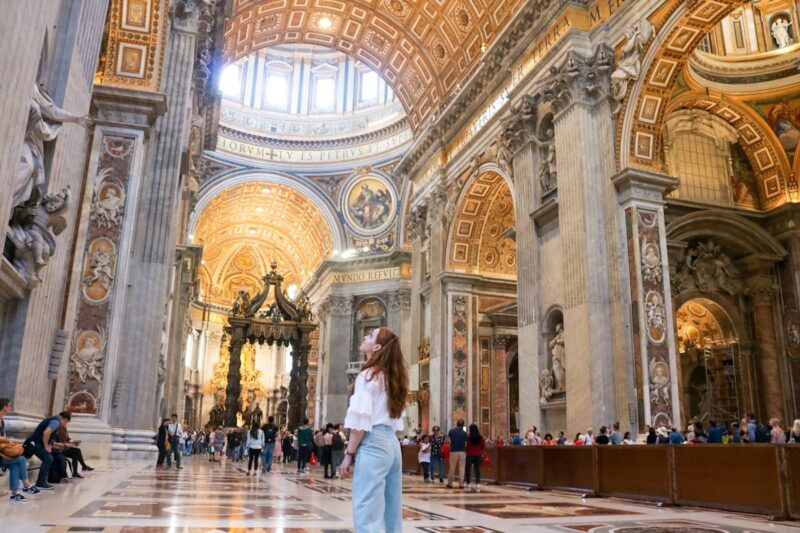
The first level is the interior gallery, which sits at the base of the dome’s interior, roughly 53 meters above the basilica floor. From here you look down into the nave and can study the dome’s mosaic decorations at close range. Each letter in the Latin inscription circling the dome’s interior is 1.5 meters tall — a detail that only registers when you are standing beside them. This level is accessible by elevator or by climbing 231 steps.
The second level is the exterior observation deck at the very top, another 320 steps above the gallery. There is no elevator for this section. The staircase narrows progressively — the final stretch is single-file, with walls that curve inward following the dome’s curvature. You hold a rope for balance. Separate up and down staircases mean you will not encounter people coming the other way, but once you start the upper climb there is no turning back.
How Much Does It Cost?
Walking all 551 steps costs €8 per person. Taking the elevator for the first 231 steps and then walking the remaining 320 costs €10. Children under 6 enter free. The ticket counter accepts cash only — no credit cards.
Online booking through the official Vatican booking system (basilicasanpietro.va) runs €22 for the basilica plus dome with elevator, which includes a digital audio guide.
The question of whether to pay for the elevator is simple: if you have any doubt about climbing 551 steps through confined spaces, take the elevator. The €2 difference is negligible. The 231 steps it saves are the easiest part of the climb — the difficult section is the final 320 steps above the gallery, which you walk regardless of ticket type.
When Is the Best Time to Climb?
The dome is open April through September from 8:00 AM to 6:00 PM, and October through March from 8:00 AM to 5:00 PM. It is closed on most Wednesday mornings until noon for the Pope’s weekly public audience.
The best time to climb is first thing in the morning, arriving by 8:00 AM. In peak season (April through October), wait times at the dome ticket counter reach 45 to 90 minutes by mid-morning.
Late afternoon is the second-best window. November through February sees the shortest queues overall — some visitors report walking directly to the ticket counter with no wait at all during winter weekday mornings.
What Will You See from the Top?
From the exterior observation deck, you can identify most of Rome’s major landmarks. St. Peter’s Square spreads directly below, with Bernini’s 140 colonnade statues visible from above — a perspective that reveals the geometric precision of the piazza’s elliptical design in a way the ground view cannot. The Vatican Gardens stretch to the north and west. Beyond the Tiber, the dome of the Pantheon, the Vittoriano monument, the Colosseum, and the Janiculum Hill are all visible on clear days.
The interior gallery view is also worthwhile. Looking down into the basilica from 53 meters gives you a sense of the building’s scale that standing on the floor cannot communicate — the nave stretches 186.36 meters from entrance to apse.
Is the Climb Suitable for Everyone?
No. The final 320 steps are genuinely challenging. The staircase narrows to the point where your shoulders may touch both walls simultaneously. The ceiling lowers as the dome curves inward, and the steps are uneven. The temperature inside the dome’s double shell can significantly exceed outside temperatures, particularly in summer when interior readings can exceed 35°C.
The Fabbrica di San Pietro explicitly advises against the climb for visitors with heart conditions, claustrophobia, vertigo, respiratory issues, or mobility difficulties, as well as pregnant women. Children under 7 are not recommended.
How Does the Dome Fit into a Vatican Day?
The most efficient sequence is to visit the dome first, then the basilica interior, and then walk to the Vatican Museums. For visitors planning a 3-day Rome itinerary, the dome climb pairs naturally with the basilica visit and should be scheduled on the same day as the Vatican Museums. Allocate at least 4 hours total for museums, basilica, and dome combined — 5 hours if queues are significant.
Frequently Asked Questions
Can you turn back once you start climbing?
You can turn back from the gallery level. Once you begin the upper 320-step climb to the exterior deck, the staircase is one-way and there is no return route until you reach the top.
Are there bathrooms on the way up?
Yes. The terrace at the base of the dome (the first level) has restrooms, a gift shop, a refreshment area, and a Vatican post office. There are no facilities during the upper climb itself.
Do you need to book dome tickets in advance?
You can buy tickets at the on-site counter (cash only), but queues in peak season run 45 to 90 minutes. Online booking through basilicasanpietro.va secures a timed entry slot and includes the audio guide, though it costs more than the walk-up price.
What should you wear?
Comfortable closed-toe shoes are essential — the steps are stone and uneven. The Vatican’s dress code applies: shoulders and knees must be covered. Bring water, as the climb generates considerable heat, especially in warmer months.
How long does the full climb take?
Plan 45 to 60 minutes total: roughly 15 to 20 minutes ascending, 10 to 15 minutes at the top, and 10 to 15 minutes descending. The descent uses a separate staircase.